

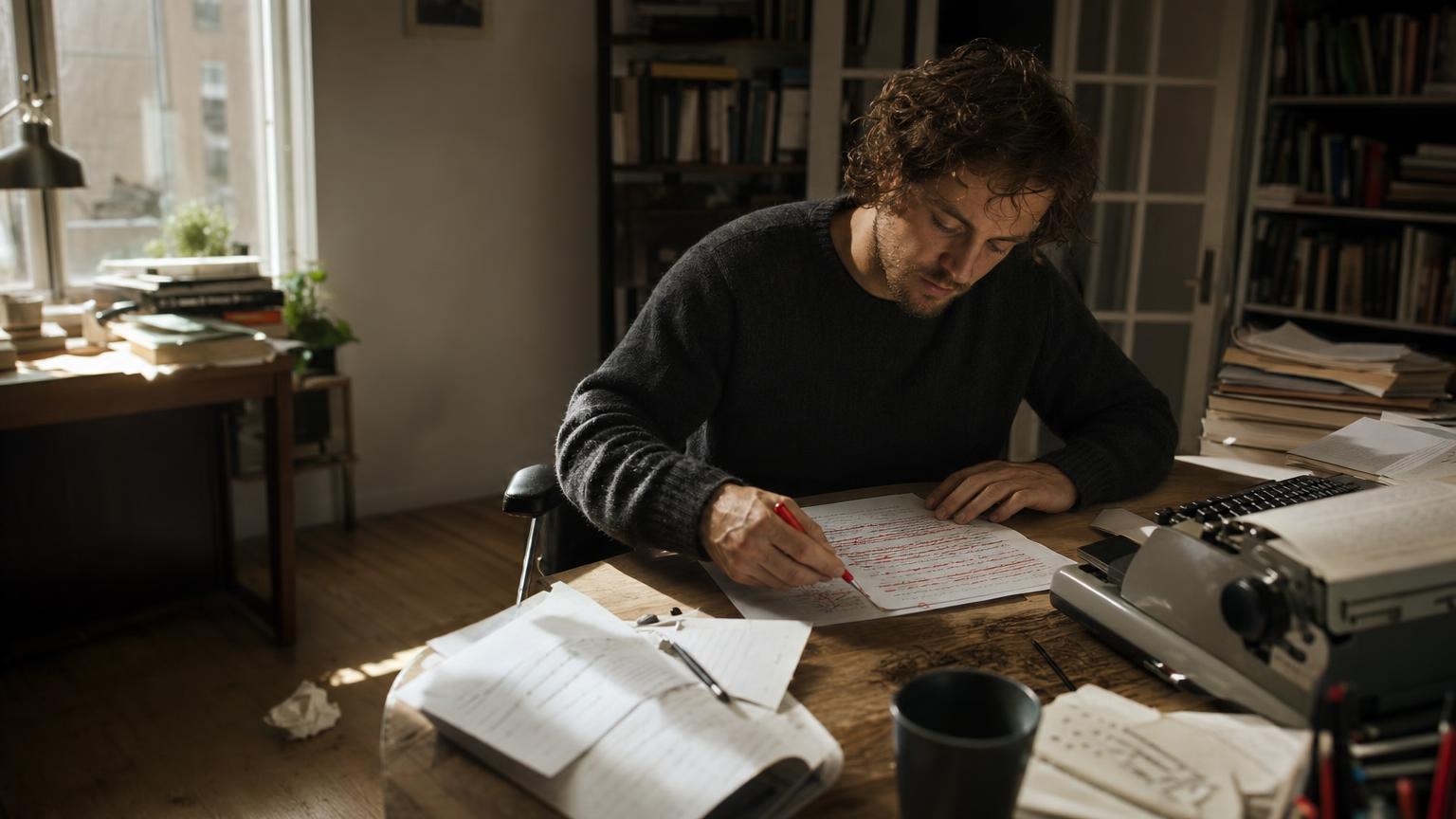
A slush reader at a literary agency reads somewhere between 50 and 300 first pages a week, depending on the agency and the season. When you read that many openings back to back, patterns stop registering as a vague bad feeling and start registering instantly — the way a repeated chord progression jumps out to a musician before anyone else notices something's off.
That's the real story behind "agents are tired of this opening." It's not a blacklist. It's pattern recognition running at high speed on a tired brain at 11 p.m. The seven openings below aren't bad because a rule says so — they're bad because, nine times out of ten, they're a symptom of the same problem: the manuscript starts before the story actually starts. Fix that, and the "banned" opening usually fixes itself.
If you haven't already, it's worth reading what great first lines actually do before this one — that piece covers the sentence level; this one covers the structural traps that happen one beat earlier, in the first page or two.
Why These Openings Keep Showing Up
These seven openings aren't actually forbidden. You could point to a published novel that opens with each one. The problem isn't the device — it's that most writers reach for these specific openings for the same reason: they're the easiest way to start writing before you've figured out where your story actually begins.
Waking up is easy to write because it's a blank slate you already understand. A mirror is easy because you need to tell the reader what your character looks like and a mirror is right there. Weather is easy because it's the first thing anyone notices stepping outside. None of these are wrong at the sentence level. They're wrong because they let you avoid the harder work of finding the moment where something changes.
So when an agent reads a waking-up opening, they're not thinking "ugh, not this again" out of snobbery. They're thinking: this manuscript probably doesn't start for another page or two. And they're usually right.
The Waking-Up Opening
Your protagonist wakes up. They notice the ceiling, the light through the curtains, how they slept. Maybe there's a line about what day it is. This is the opening equivalent of clearing your throat — it's you, the writer, warming up before you say the actual thing.
The problem isn't consciousness itself. It's that waking up is, by definition, a character alone with their own thoughts before anything is at stake. Nothing is being decided. Nothing is in motion. The reader is asked to care about a person doing the one thing every human does every day, with zero information about why this particular morning matters.
Salvage move: you don't have to cut the waking moment — you have to cut in later. Instead of opening with the character surfacing into an ordinary morning, open after something has already gone wrong: the phone's been ringing for ten minutes, there's a stranger's voice downstairs, the room is the wrong temperature. Now the first lines carry a question — why is the phone ringing? who's downstairs? — instead of a routine. The character can still be groggy and disoriented; that's fine, even useful. But the disorientation should be doing work, not just passing time until the plot arrives.
The Mirror Description
The character walks to the bathroom, looks in the mirror, and the reader gets two paragraphs of hair color, eye color, the shape of a nose, maybe a scar with a story attached. It's an old enough move that it has its own nickname in writing circles — "the mirror trick" — and agents clock it fast, often before they finish the paragraph.
The reason it reads as a shortcut is that it's not characterization, it's inventory. Nobody stands in front of a mirror cataloguing their own face in detail; people notice mirrors when something's different — a bruise, new gray hair, how tired they look — or not at all. A description that exists purely to get information to the reader, with no reason for the character to be thinking it, feels like exactly what it is: the author reaching through the page to hand you a character sheet.
Salvage move: let other people do the noticing. A character's appearance lands harder through how someone else reacts to it — a guard who hesitates, a sister who says "you look like Dad when you do that" — than through self-description. Or let your character notice one detail, and only because it's wrong or changed: a hand that won't stop shaking, a dress that no longer fits, a face in a window reflection that looks older than expected. One specific, motivated detail beats a full inventory, and it tells the reader something about the character's state of mind, not just their face.
The Weather Report
"It was raining the night everything changed." "The sun rose over the valley, golden and indifferent." These openings aren't badly written — some of them are quite pretty — but they delay the thing readers actually showed up for, which is a person in a situation. Weather on its own carries no stakes. It's scenery before there's anyone to put it in front of.
Salvage move: the fix isn't "never mention weather," it's "never let weather stand alone." Make it do double duty in the same sentence it's introduced — tie it directly to the character's situation or mood so it's part of the first thing happening, not a separate scene-setting beat before the story starts. "The rain hadn't let up in three days, which was good, because it meant no one was out looking for footprints" does in one sentence what a full paragraph of atmosphere can't: it gives you sky and stakes at once.
The Dream Sequence
The opening scene is tense, vivid, maybe even violent — and then the character wakes up, and none of it actually happened. It's a trick that works exactly once per career, usually in someone else's book you remember because it was unusual at the time. By now, readers — and agents especially — have been burned by this enough times that it reads as a small betrayal rather than a clever structural move. You've asked them to invest in stakes that turn out to be fake, on the first page, before you've earned any trust at all.
Salvage move: if the dream genuinely matters — if it's planting an image or fear you'll pay off later — ground it in physical stakes within the dream itself, so the sequence works as its own scene rather than existing only to be revealed as unreal. Even better: move it later in the manuscript, once the reader already has a reason to care about the character and won't feel cheated to learn the danger wasn't "real." Trust is a resource you spend. Don't spend it on a twist whose only payoff is "none of that mattered."
The Info-Dump Backstory
Before any character speaks or acts, you get the history of the kingdom, the rules of the magic system, the three wars that led to the current political situation, or the protagonist's entire childhood summarized in exposition. Agents don't read this and think "thorough worldbuilding." They skim ahead, looking for the paragraph where the actual story starts. If they have to skim on page one, that's the whole read.
The instinct behind it is reasonable: you want the reader to understand the stakes before you show them the scene. But readers don't need to understand everything to be interested — they need one concrete, specific thing happening that makes them want to understand more.
Salvage move: pick one scene that implies the backstory rather than stating it, and trust the reader to infer the rest. A child hiding food under a floorboard tells you about scarcity and fear faster than a paragraph about the famine. A soldier flinching at a knock on the door tells you about the war without a timeline. If you're worried about orienting readers in a built world, the approach in worldbuilding beyond the map is useful here too — texture through behavior, not briefing.
The Alarm Clock / Daily Routine Montage
This is the waking-up opening's cousin: instead of one morning, you get the character's whole routine — breakfast, commute, small talk with a coworker, the normal rhythm of an ordinary day — before the inciting incident finally shows up on page three or four. The instinct is to establish "normal" so the reader can feel the disruption when it comes. The effect is usually the opposite: it signals that nothing has changed yet, so there's no reason to keep reading yet either.
Salvage move: start on the day everything stops being routine, not the routine itself. You can still reference the normal pattern, but only in the moment it breaks. "She'd taken the same train for six years, which was how she knew immediately that the man in the third car didn't belong" gives you the routine and the disruption in the same breath, instead of one, then the other, several paragraphs apart.
A Fast Self-Test for Your Own First Page
Before you touch a word of your draft, run your current opening through this:
- Is there a want? Does your character need something, even something small, in the first page?
- Is there a problem? Is something already wrong, or about to be?
- Is something in motion? Could a reader describe what's happening in your first paragraph as an event, not a state?
If the answer to all three is no, your opening is probably a setup for the story rather than the story — exactly the trap all seven openings above share.
Test this on actual readers, not just yourself. Hand your first 200 words to a few people cold, with no context, and ask what questions they have at the end — not what they liked, specifically what they're wondering. If the honest answer is "nothing, really," that's your signal.
Try This Now
Take your current opening — the actual page you have right now — and do this:
- Check it against the seven patterns above. Which one does it resemble, even loosely?
- Find the first moment on that page where something is actually happening — a want, a problem, a change in motion.
- Rewrite the opening paragraph starting there instead. Cut everything before it. Yes, even if you like the sentences.
- Read the new first paragraph cold. Does it raise a question the old one didn't?
Most writers find their real opening is one or two pages later than where they started — the "clearing your throat" material was doing exactly that, and nothing more. That's not wasted writing. It's just not your opening page.
And if the blank page is the actual obstacle — if you know your old opening doesn't work but every replacement feels equally stuck — that's a reasonable place to draft fast with Just Write and get a workable version down. A rough opening you can revise against beats a perfect opening you're still staring at next week.