

Your Map Is the Least Interesting Part of Your World
You know the drill. Before you write a word of chapter one, you draw the continents. You name the mountain ranges. You sketch four hundred years of dynastic history nobody will ever read, including you, six months from now.
Readers don't believe in your world because of the map. They barely glance at it. What makes a culture feel real is texture — the small, specific, sensory stuff that surfaces in scene. A character wincing at an insult. A coin that's the wrong size for the pocket it's in. A dish nobody in the room will finish because of what it's traditionally served at.
Think of it as an iceberg: most of your culture lives underwater, invisible to the reader, and it should stay there. The only part that needs to show up on the page is the tip — the specific detail that implies everything beneath it. A reader doesn't need your trade agreements. They need one line of dialogue that makes clear this culture treats debt as a moral failing, and they'll build the rest themselves.
This isn't an argument against worldbuilding. It's an argument against surfacing it in the wrong place. The iceberg still needs mass underneath, or the tip will feel randomly generated. But that mass is for you, not the reader — a private resource you draw from, not a document you deliver.
The rest of this post is a set of shortcuts for building that mass fast, and for making sure it actually reaches the page as texture instead of exposition.
Feed Your Characters Something Specific
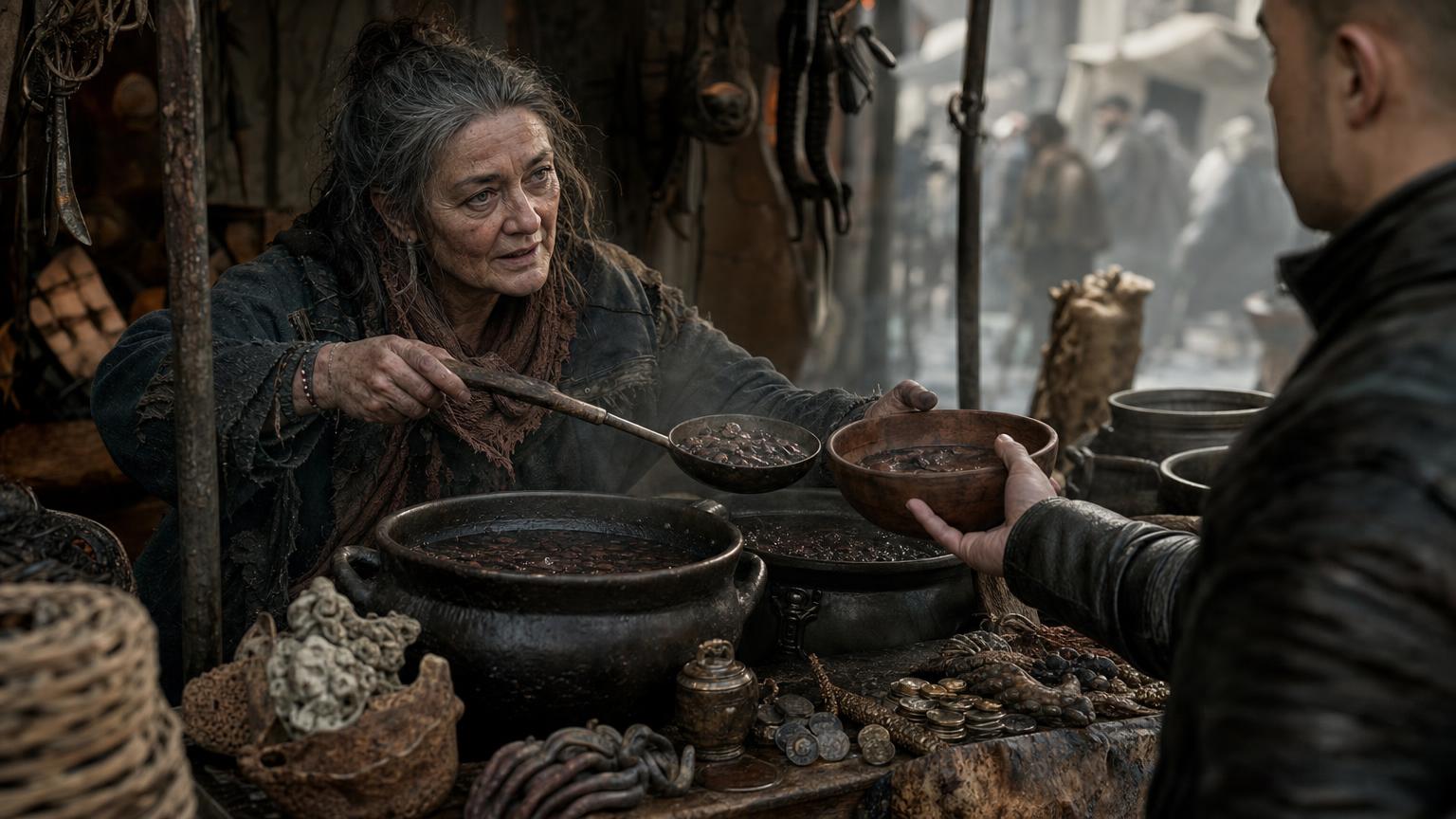
Food is the highest-leverage detail in worldbuilding, and it's underused because it seems too small to matter. It matters because one dish can imply climate, class, trade routes, and ritual simultaneously, without you explaining any of them.
Compare:
They sat down and ate bread.
She tore off a corner of the seed-cake — the kind only baked on debt-clearing days — and didn't offer him any.
The second version hasn't told you anything directly, but you now know: this culture marks financial transactions with specific food, that food carries enough weight that withholding it is a social move, and this character is making that move on purpose. You got class tension, ritual, and character motivation from one sentence about cake.
When you're inventing a dish, anchor it to one of four things: a scarce local ingredient, a taboo (what's never eaten, or never eaten by certain people), an occasion (funerals, debt, coming-of-age), or a memory of hardship (the "poverty food" that became a comfort food, or vice versa). You don't need a whole cuisine. You need one dish that does real work in one scene.
Follow the Money to Find the Culture
If food is the fastest shortcut, economics is the deepest one. What's scarce in a society, what functions as currency, and who owes whom generates conflict and dialogue for free — you don't have to invent tension, you just have to ask who wants the scarce thing and who's standing between them and it.
Scarcity is more useful than abundance here. A culture with abundant grain and scarce salt will have completely different manners, insults, and power structures than one where it's reversed. Salt-scarce cultures might treat hospitality as a status weapon — who can afford to salt a guest's food is who has power in the room. That's a scene. That's dialogue. You didn't write a page of economic history to get there; you just picked the scarce thing and asked who controls it.
Try this before you draft a scene in a new setting: pick one resource that's scarce. Ask who controls access to it, who resents that control, and how that resentment shows up in a single interaction — a loaded offer, a refused gift, a debt mentioned in passing. That's your scene's undercurrent, and it took two minutes to generate. The same logic that drives character motivation applies at the cultural level — people act from want and lack, and economies are just want and lack at scale.
Insults, Oaths, and Slang Reveal What a Culture Fears
Nothing compresses a value system faster than an insult. What a culture considers the worst thing you can call someone tells you what it's most afraid of losing.
"Coward" in a warrior culture is close to unforgivable — it threatens the thing that culture organizes itself around. In a merchant culture, the sharper insult might be "debtor" or "unweighed" (someone whose word can't be trusted at scale). In a culture obsessed with bloodline purity, the worst thing you can say to someone probably references parentage, not personal failing.
Build three to five invented insults or oaths, and tie each one to a specific cultural fear:
- Debt — an oath like "may your name outlive your credit" as a genuine curse, not a joke.
- Dishonor — an insult that translates roughly to "unwitnessed," implying that acts done without an audience don't count and can't redeem you.
- Impurity — a slur built around mixing (of blood, of trade, of land) in a culture obsessed with lineage.
- Weakness — an oath sworn "on the second knee," referencing a culture where kneeling twice signals total submission, so invoking it is a serious promise.
- Exposure — a curse wishing someone "unroofed," in a culture where shelter is scarce enough that homelessness is the worst fate imaginable.
None of these required a paragraph of explanation. That's the point — the insult does the worldbuilding, and the reader infers the fear behind it. It's the same principle behind subtext in dialogue: characters saying one specific thing that implies a much larger unspoken thing.
Texture Over Exposition: Show the Iceberg Tip
The technique for all of this is the same: drop the detail into action or dialogue, and don't stop to explain it.
The classic failure mode is the "as you know" info-dump — two characters who both already know their culture's history explaining it to each other for the reader's benefit. It's a tell, and readers feel talked at rather than immersed. If your character wouldn't naturally think about it, don't have them think about it.
A useful rule of thumb: one telling detail per scene beats one paragraph of backstory, every time. Instead of explaining that this culture views debt as spiritually contaminating, show a character physically flinch when offered a loan, and let that flinch do the work. Instead of a history-lecture paragraph about a war fifty years ago, have an old character refuse to sit at a table with a particular family name on it, unexplained. The reader doesn't need the footnote. They need the reaction, and they'll trust you to fill in the reason eventually — or they'll enjoy not fully knowing.
This is the same instinct behind good setting description: specific, sensory, and earned through action beats comprehensive and explained up front.
Build the Underwater 90% (But Don't Dump It on the Page)
None of this means skip the deep worldbuilding — it means keep it private. Build a culture bible for yourself: notes on the economy, the food, the slang, the oaths, the taboos. Nobody reads this but you, and its only job is consistency. If you establish in chapter three that salt is sacred, your bible reminds you in chapter twenty that a character wouldn't casually salt a stranger's food without it meaning something.
The risk with a private reference document is that it sprawls, gets disorganized, and becomes its own procrastination project — worldbuilding as a way of avoiding the actual manuscript. Keep it lean and keep it attached to the draft, not separate from it.
For names specifically — people, places, invented terms — it's worth reading how to name fantasy characters and trying the fantasy name generator before you commit to a dozen apostrophe-heavy proper nouns that will exhaust your reader by chapter two.
A Fast Drill: Build One Culture in 20 Minutes
Here's the whole method compressed into a timed exercise.
Pick one scarce resource. Pick one dish tied to it. Pick one insult tied to a cultural fear. Pick one oath tied to the same fear or a related one. Four details, fifteen minutes to choose them, five minutes to write a 200-word scene using only those four — no other invented history allowed.
Try it: resource is fresh water, dish is a bitter tea rationed to guests as a hospitality display, insult is "cistern-empty" (meaning someone who takes without giving), oath is "by the last cup." Write two characters negotiating something — a trade, a favor, a marriage — and force all four details into the scene naturally. The scene practically writes its own conflict, because scarcity plus ritual plus insult is already most of what tension needs.
The real payoff is that this scales. A series with six distinct cultures doesn't need six invented histories before you start drafting — it needs six sets of these four details, which you can generate in under two hours total. You fill in the underwater mass as you go, scene by scene, instead of front-loading years of prep that delays the actual writing.
Try This Now
Before your next scene set in an unfamiliar culture, do this:
- Name the scarcity — the one resource this culture doesn't have enough of.
- Name the dish — one food tied to that scarcity, a taboo, or an occasion.
- Name the insult — one word or phrase that encodes what this culture fears most.
- Write the scene — 200 words, using only those three details plus whatever plot you already have. No history lecture allowed.
If you get through the drill and find yourself wanting to stall on a fourth culture bible page instead of actually writing the scene, notice that — it's a very comfortable way to avoid drafting. If you want help turning these details into an actual scene instead of another set of notes, Just Write can help you draft dialogue and prose that puts the texture to work instead of explaining it.