

Why Revising Line by Line First Wastes Your Time
You finish the draft, open to page one, and start polishing. Tighten this sentence. Cut that adverb. Find a better verb for "walked." It feels productive — you're making the writing better, sentence by sentence, and by page thirty you're proud of how clean it reads.
Then, in week three, you realize chapter one has to go. The story actually starts in chapter four. All that polish just got deleted along with the pages you cut.
This is the most common trap in revision, and it's not a discipline problem — it's an ordering problem. Line editing feels like progress because you can see it happening in real time. But if the scene doesn't belong in the book, or belongs somewhere else, no amount of sentence-level polish will save it. You're decorating a room you haven't decided to keep.
Think of revision as demolition before decoration. A contractor doesn't sand and paint a wall before deciding whether it's load-bearing and needs to move. They tear out what doesn't work, confirm the frame is sound, and only then bring in the finish work. Novels work the same way. Structure first, because structure is expensive to discover late. Sentences last, because sentences are cheap to redo and cheap to lose.
The fix is a revision order: diagnose the shape of the draft you actually wrote, fix the big bones, check that every scene earns its place, and only then go sentence by sentence. Here's how each pass works.
Step One — Diagnose the Structure
Before you can fix a draft's structure, you need to see it — not the structure you intended when you outlined the book, but the one that actually exists on the page after however many detours the writing took.
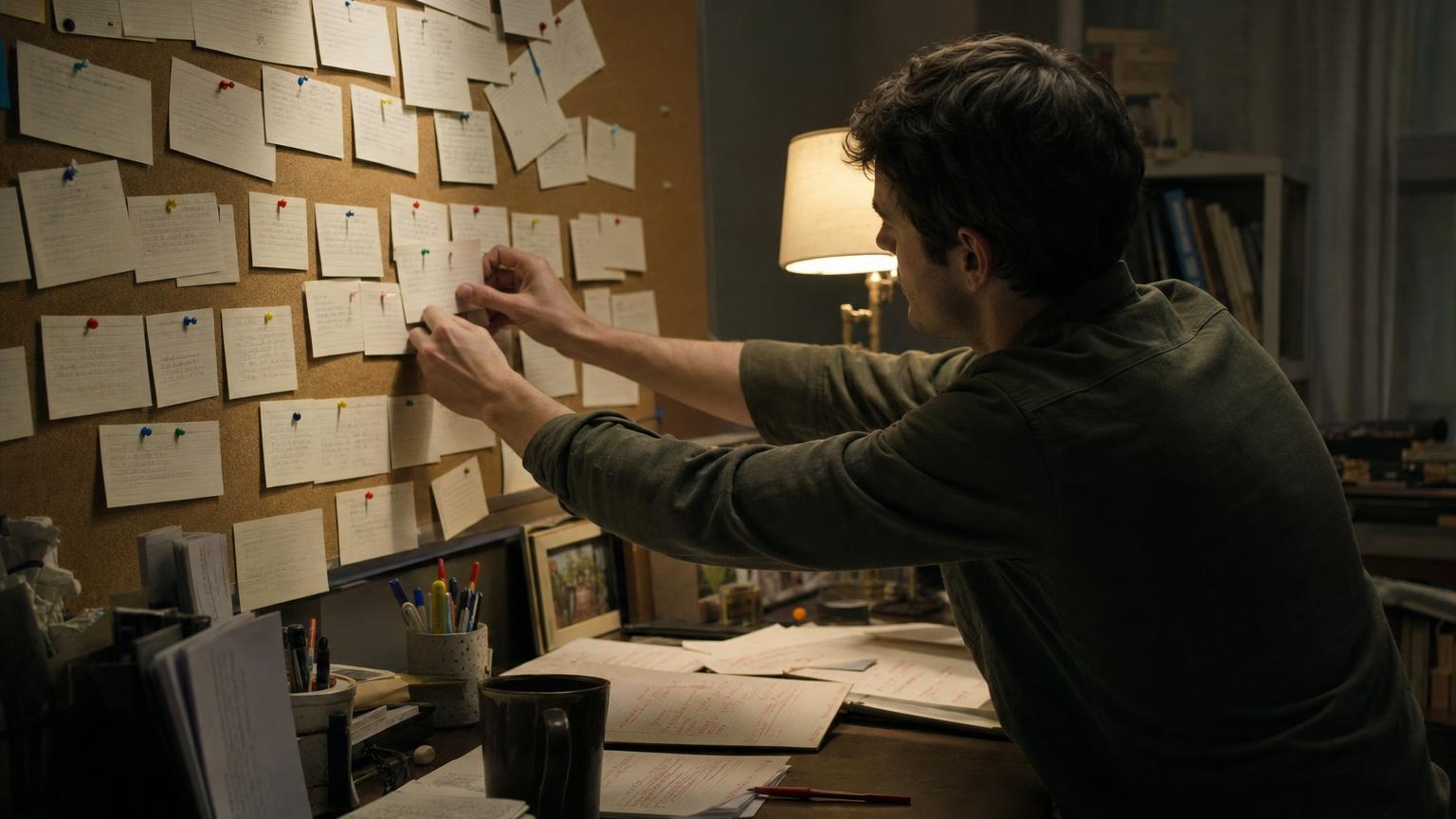
The tool for this is a reverse outline: a one-page scene list built from the draft you have, not the plan you started with. Go chapter by chapter and, for each scene, write one line covering:
- What happens (the event, not the mood)
- Whose scene it is and what they want in it
- What changes by the end of the scene
Keep it to one page if you can. If a scene resists being summarized in a sentence, that's already useful information — it usually means the scene doesn't know what it's for.
With the list in front of you, ask the diagnostic questions:
- Does the midpoint actually turn the story, or is it just the scene that happens to be in the middle?
- Does the ending pay off the promise the opening made, or has the story quietly become about something else?
- Where does momentum sag? Look for three or more scenes in a row where nothing changes for anyone.
- Is there a scene where the inciting incident should be, or has it drifted in late?
You're not fixing anything yet. You're mapping the terrain so the fixes you make next are aimed at real problems instead of guesses.
Step Two — Fix the Big Bones Before Anything Else
With the scene list in hand, do the structural surgery now, while it's still cheap. This is the stage for:
- Reordering scenes. If your reverse outline shows the inciting incident buried in chapter four, move it. Readers give a book roughly one chapter of patience before they need to know what it's about.
- Cutting subplots that don't pay off. If a subplot doesn't intersect the main plot or change the protagonist by the end, it's weight, not story. Cut it, even if individual scenes in it are well written.
- Merging redundant characters. Two allies who serve the same narrative function — comic relief, moral conscience, exposition delivery — can usually become one character with more room to breathe.
- Moving the inciting incident earlier. The single most common structural fix in a first draft. Writers often spend three chapters on setup that readers need three paragraphs of.
The reason to do this now, before line editing, is simple economics: it's much easier to cut a chapter you haven't polished. Writers get attached to sentences they've sweated over, and that attachment makes necessary cuts feel like losses instead of fixes. Cut early, while the prose is still rough enough that letting go doesn't hurt.
If you find yourself defending a scene because "it's some of my best writing," that's a warning sign, not a case for keeping it. Beautiful writing in the wrong place still slows the book down.
Step Three — Revise Scene by Scene
Once the overall shape holds — the right scenes exist, roughly in the right order — move down a level and evaluate individual scenes for purpose.
Every scene should answer three questions:
- Goal — who wants what in this scene?
- Conflict — what's stopping them from getting it easily?
- Turn — what's different at the end of the scene than at the start?
If a scene has no clear goal, it's probably a scene about atmosphere or backstory that could be a paragraph instead of a chapter. If there's no conflict, it's a transaction, not a scene — information changes hands, but nothing is at stake. If there's no turn, the scene may be well written but structurally inert; cutting it should change nothing else in the book, which is exactly why it can go.
This is also the right level to check things like subtext in dialogue and whether a character's actions track with their established motivation — problems that live in the scene's design, not its sentences. Fixing them here might mean rewriting a scene's content entirely. That's fine. It's still cheaper than fixing it after you've polished the prose.
Step Four — Only Now, Revise the Sentences
With structure sound and every scene earning its place, you can finally do the line-by-line work that felt so tempting on day one: rhythm, voice consistency, clarity, word choice.
This is where you catch the small stuff — the sentence that's grammatically fine but limps when read aloud, the description that oversells a setting your reader could picture in half the words, dialogue tags doing work the dialogue should be doing itself. Reading scenes aloud catches problems your eye skims past. Awkward rhythm and stilted dialogue are much easier to hear than to see.
Doing this work earlier means doing it twice. A gorgeously line-edited scene that gets cut in step two was wasted effort; a scene that gets rewritten in step three erases whatever line editing happened before it. Sentence-level polish is the last thing that should touch the manuscript, because it's the only pass where the text you're working on is guaranteed to survive.
A Triage Checklist for Each Pass
Keep this nearby and work through it in order. Time-box each pass — give yourself a set number of days per stage — or "revision" quietly becomes "polishing forever."
Structure pass
- Does the reverse outline show the story you meant to write?
- Does the inciting incident happen early enough?
- Does the midpoint turn the story?
- Does the ending pay off the opening's promise?
- Mark each scene: keep, cut, merge, or move.
Scene pass
- Does this scene have a clear goal, conflict, and turn?
- Does something change by the end of it?
- Could this scene be cut without breaking anything downstream? (If yes, consider cutting it.)
- Is this the earliest point in the story this scene could happen?
Line pass
- Does this sentence sound like this character, in this narrator's voice?
- Would this read better aloud with different rhythm or shorter clauses?
- Is there a stronger, more specific word doing the job of three weaker ones?
- Does the dialogue carry subtext, or is it just characters stating what they want?
When to Stop Revising
Revision doesn't end when the manuscript is perfect — it ends when further changes stop being fixes and start being preferences. That's the clearest sign a draft is done enough: you're swapping one good word for another equally good word rather than solving a real problem.
Other signs you're near the finish line:
- Returns are diminishing. Each new pass changes less than the last one.
- Feedback from readers is converging rather than conflicting. If three beta readers flag the same soft middle, that's a real problem. If three readers each like a different chapter best and dislike a different one, you may be at the point of diminishing returns.
- You're rereading out of anxiety rather than curiosity — looking for reassurance, not information.
At that point, get outside eyes on it. A manuscript can only be revised so far in isolation before you're just refining your own blind spots. Beta readers or an editor will catch what a tenth solo read-through won't, and their reactions will tell you whether the structural work in steps one and two actually landed.
Try This Now
Before you touch a single sentence of your current draft, build the one-page scene list. Chapter by chapter, note what happens, whose scene it is, and what changes. Then mark each one: keep, cut, merge, or move.
Don't rewrite anything yet. Just look at the shape you actually have. You'll likely find a subplot that never pays off, two characters who could become one, or an inciting incident buried three chapters too deep — the kind of thing no amount of sentence polish would have shown you.
Once your structural plan is set and you know which scenes need to be rewritten from scratch or added to fill a gap, drafting the replacements is its own task — and if you want help getting new or reworked scenes onto the page quickly once the plan is clear, Just Write is built for exactly that stage of the process.
Checklist for today:
- Build the one-page reverse outline.
- Mark every scene: keep, cut, merge, move.
- Answer the midpoint and ending questions.
- Resist the urge to fix a single sentence until the map is done.