

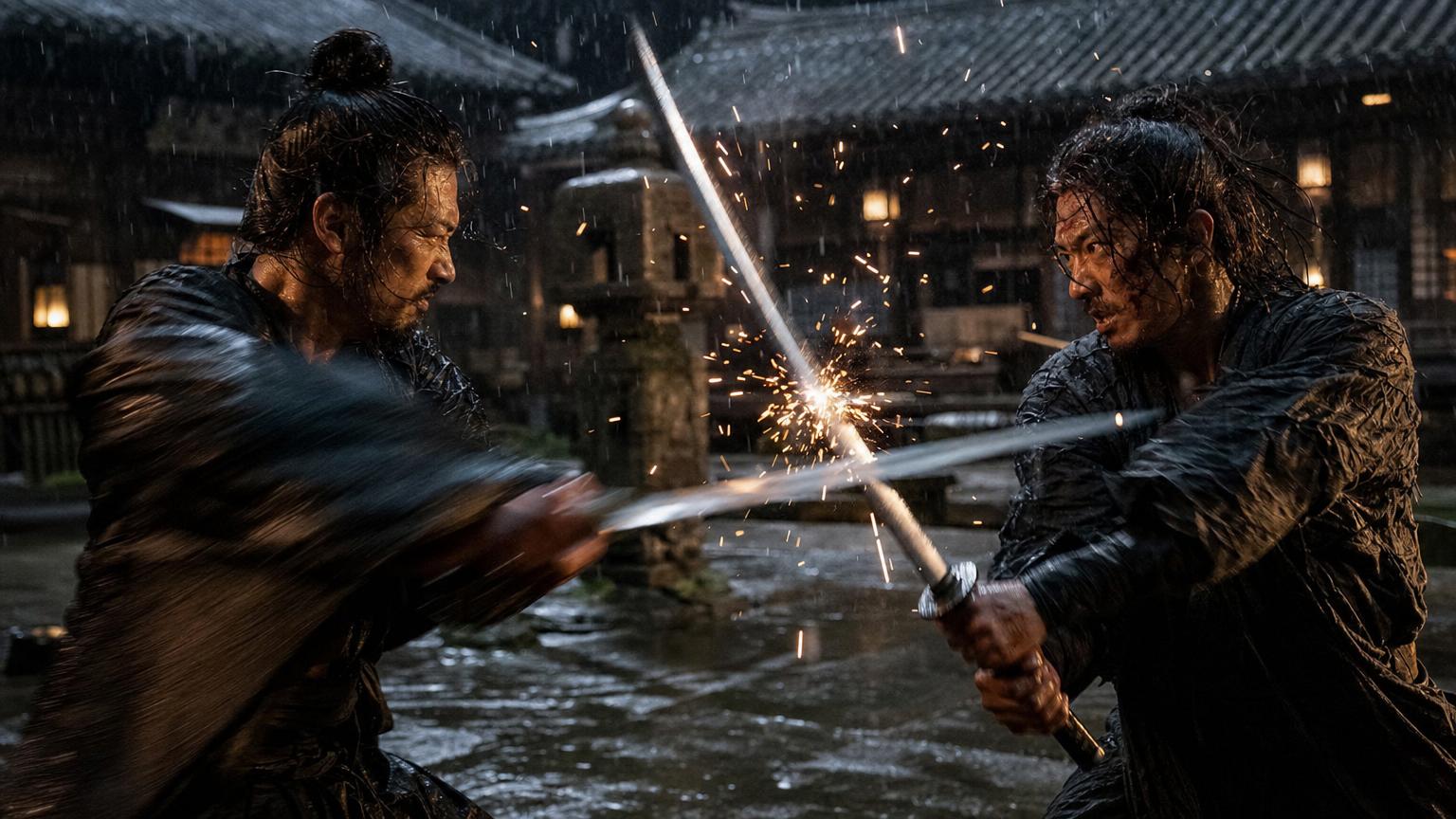
Most fight scenes fail before the first punch is thrown. Not because the choreography is wrong, but because the reader has no reason to care who wins. A fight scene is not a sequence of movements — it is a scene, with everything that implies: stakes, character, and change. The blows are just the medium.
Here is how to write one that earns its place in your story.
Decide what the fight is actually about
Every memorable fight is about something other than the fight. Rocky isn't about boxing; it's about a nobody proving he can go the distance. The throne room duel in your fantasy novel isn't about swordplay; it's about a son finally standing up to his father.
Before you write a single move, answer two questions:
- What does each fighter want that the other is preventing? "To win" is not an answer. Escape, protect someone, buy time, prove something, retrieve the item — those are answers.
- What changes because this fight happened? If you could delete the scene and replace it with "they fought; she won" without losing anything, the scene doesn't deserve its pages yet.
If you're still developing who these characters are and what drives them, our free character personality generator is a quick way to rough out the motivations and flaws that give a fight its subtext.
Stakes first, fists second
Readers care about a fight in exact proportion to what's riding on it. So establish the cost of losing before the first exchange — not during it.
- Physical stakes: injury, capture, death. The bluntest instrument, and the weakest on its own, because readers know the protagonist rarely dies in chapter twelve.
- Emotional stakes: humiliation in front of someone who matters, the friend watching who will be next, the promise about to be broken.
- Story stakes: the caravan escaping while the hero is pinned down, the ritual completing behind the duel.
The strongest scenes stack all three. A duel where losing means death and the city gates open and her brother sees her fail is a scene readers cannot skim.
Choreograph less than you think you need
The most common beginner mistake is the blow-by-blow: he swung, she ducked, he lunged, she parried. Readers don't process fight choreography the way viewers process a film — they process sensation and consequence.
Pick three to five key beats — the moments where the fight's direction changes — and render only those in detail:
- The moment your hero realizes she's outmatched.
- The dirty trick that turns the tide.
- The mistake that will cost someone.
Everything between the beats can compress into a sentence or two of blur: Two minutes of trading ground, and her arms already burned. That compression is not cheating; it's how bodies actually experience violence — flashes of clarity in a smear of adrenaline.
Use sentence rhythm as choreography
Your prose rhythm is doing more work than your verbs. In fast moments, use short sentences. Fragments, even. One image each.
Then, when the tempo breaks — a grapple, a standoff, a pause with both fighters heaving — let the sentences lengthen again, giving the reader room to breathe exactly when the characters do.
Read your draft aloud. Anywhere you stumble, your reader will too. A fight scene with uniform sentence length feels like a metronome, and metronomes are the opposite of danger.
Ground every exchange in the senses of one body
Stay in one point of view and stay inside it. Not "the knife glinted" but "the knife was suddenly the only thing in the room." Give the reader:
- Pain that has texture — not "his shoulder hurt" but "his shoulder had gone hot and loose, and his fingers weren't answering."
- The environment as a weapon — the gravel underfoot, the table between them, the low ceiling that rules out a swing. Fights happen somewhere, and the somewhere should matter.
- Sensory narrowing — under adrenaline, hearing drops out, vision tunnels, time distorts. Use it. It's realistic and it's atmospheric.
Let competence have a cost
Perfect fighters are boring. Even if your protagonist is the best swordsman in the city, the fight must cost something: a wound, a revelation, a line crossed. Winning ugly is almost always more interesting than winning clean.
And if your character loses — even better. A protagonist's loss in the middle of a book is one of the most reliable engines of reader investment ever discovered. It sets stakes for the rematch that no amount of description can buy.
The aftermath is half the scene
The paragraphs after the last blow are where the fight becomes story. Adrenaline crash. Shaking hands. The look from the bystander that says everything has changed. The body — because if someone died, someone has to deal with that, emotionally and literally.
Skipping the aftermath is like cutting a joke before the punchline. The fight was the setup; the consequences are the payoff.
A quick revision checklist
When you redraft your fight scene, check:
- Can the reader say in one sentence what this fight is about?
- Are the stakes on the page before the first blow?
- Are there three to five distinct beats, or is it an undifferentiated flurry?
- Does sentence length vary with tempo?
- Does the setting participate?
- Does the winner pay a price?
- Is there an aftermath with emotional weight?
If you can tick all seven, you have a scene — not just a fight.
Practice on a scene that doesn't matter yet
The fastest way to internalize these techniques is to write a fight that carries no pressure: a practice scene, unattached to your novel. Grab a scenario from our free writing prompt generator — or spin up a quick antagonist with the character name generator — and give yourself 500 words to hit three beats, vary the rhythm, and land an aftermath.
And when you're ready to put a real fight into a real story, Just Write can help you draft it: sketch the beats you want in your outline, and it expands them into full prose while keeping your characters, stakes, and style consistent from the first blow to the bruises after.